
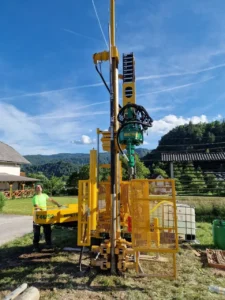


The pressuremeter test is one of the most informative in-situ geotechnical investigation methods. It is used to determine deformation and strength properties of soils and rocks without sampling and without disturbing the natural state of the ground. The method is based on measuring the ground’s response to a radial load applied in a borehole by a special instrument—the pressuremeter.

Principle of operation
A pressuremeter is a cylindrical probe (most commonly with an elastic membrane) inserted into a predrilled borehole. The probe is inflated with fluid or gas under controlled pressure. The pressure causes radial expansion of the membrane and thus loading of the borehole wall.
Two parameters are measured:
-
the pressure in the probe, and
-
the magnitude of radial deformation of the borehole wall.
From the “pressure–radial deformation” relationship, a pressuremeter curve is plotted.
Test methodology
Borehole preparation
-
Drill the borehole to the required depth.
-
Keep the borehole diameter as close as possible to the pressuremeter diameter (minimal clearance).
-
Ensure the borehole wall is as undisturbed as possible.
Probe installation
-
Lower the probe to the target depth.
-
Center the instrument and seat it tightly.
Loading
-
Increase the chamber pressure stepwise.
-
After each increment, wait for deformation to stabilize.
-
At a critical pressure, the soil/rock structure fails.
Data logging
-
Record pressure values and the corresponding radial deformations.
-
Plot the loading curve from the measured points.
Result processing
-
Determine the deformation modulus (Eₘ), the yield pressure, and the conventional strength.
-
Compare results with code/reference values (e.g., Eurocode 7).
Characteristic parts of the curve
-
Linear segment — elastic behavior.
-
Nonlinear segment — onset of plastic deformation.
-
Break/peak — strength limit.
-
Post-peak — failure and residual deformations.
Types of pressuremeters
Menard pressuremeter (soil PMT)
Developed in France in the 1950s (Jean Menard). Used in soft to medium-dense soils (clays, silts, sands). Operates at pressures typically up to about 2–5 MPa. An elastic membrane expands against the borehole wall. Enables determination of deformation modulus and foundation bearing capacity.
OYO rock pressuremeter
Manufactured by OYO Corporation (Japan). Used in rocks and semi-consolidated soils where much higher pressures are required (20–50 MPa or more). The chamber is reinforced for testing hard rock masses. Enables assessment of rock deformability and fracturing.
Comparative table
|
Characteristic |
Menard pressuremeter (soil) |
OYO pressuremeter (rock) |
|---|---|---|
|
Material type |
Clays, silts, sands |
Rocks and semi-consolidated soils |
|
Pressure range |
~2–5 MPa (typical) |
20–50 MPa and higher |
|
Chamber design |
Elastic membrane |
Reinforced chamber |
|
Primary uses |
Foundations, pile capacity, embankments |
Rock-mass deformability, slope/ tunnel stability |
|
Prevalence |
Classical geotechnical method |
Specialized method (geomechanics, mining) |
Applications
-
Determination of soil and rock deformation modulus (Eₘ).
-
Assessment of pile and shallow foundation bearing capacity.
-
Stability analyses of slopes, retaining walls, and excavations.
-
Verification of design versus as-built parameters.
-
Selection of optimal ground-improvement/foundation measures.
Advantages
-
True in-situ test without disturbing natural structure.
-
Provides deformation and strength parameters in one test.
-
Applicable in soft soils and hard rocks (depending on probe type).
-
Interpretation is relatively straightforward.
Limitations
-
Requires high-quality drilling (no loosening of borehole walls).
-
Results are local and sensitive to ground heterogeneity.
-
Challenging in loose, saturated sands below the groundwater table with the Menard PMT.
-
Equipment cost is high, especially for rock pressuremeters.
Conclusion
The pressuremeter test is a reliable method for directly determining ground parameters in geotechnical investigations. The Menard pressuremeter is optimal for soft to medium-dense soils, while the OYO rock pressuremeter suits hard rocks and rock masses. Using both as needed provides a comprehensive assessment of foundation deformability—crucial for the design of demanding, safety-critical structures.