


Hydrogeology plays a key role in understanding groundwater, its flows, and their effects on the environment and on structures. In current practice, various impact analyses on structures are carried out to assess how groundwater influences the stability of civil works and natural processes. This prevents risks and reduces remediation costs.
Field investigations and supervision
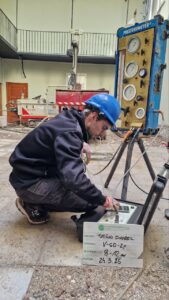 An essential part of hydrogeological work comprises field hydrogeological measurements, including groundwater-level measurements, groundwater-flow measurements, and various slug/injection tests, pumping tests, and VDP tests. These data are indispensable for determining the condition and dynamics of groundwater.
For long-term tracking, quantitative-status monitoring of groundwater and chemical-status monitoring of groundwater are conducted, providing data on the quality and availability of water resources. Special emphasis is placed on hydrogeological supervision of piezometers and piezometer maintenance/cleaning, as regular monitoring and upkeep are critical for reliable results. The same applies to hydrogeological supervision of wells, where performance and sustainable use are assessed.
Modeling and mapping
Advanced methods include the production of hydrogeological maps showing the spatial distribution of aquifers, and the development of groundwater-flow models. In addition, solute-transport models and heat-transport models are built, which are indispensable for evaluating pollutant impacts or planning the use of geothermal energy.
For projects that require spatial intervention, environmental studies for building-permit applications are often prepared, assessing impacts on the environment and water resources. In the case of natural disasters, studies for natural-disaster remediation are essential to enable rapid and effective action.
Applying hydrogeological knowledge in practice
Hydrogeology also plays an important role in energy and industry. The design of geothermal-energy utilization is based on precise data on groundwater dynamics and thermal characteristics. Equally crucial is determining sources of process/industrial water used in various industrial processes.
When structures are damaged due to groundwater impacts, specialists carry out the remediation of infrastructure assets, drawing on hydrogeological data and field-measurement results.
Conclusion
Comprehensive hydrogeological investigations and monitoring enable the sustainable management of groundwater resources and the safe planning of spatial and infrastructure interventions. By integrating field measurements, modeling, and environmental studies, we can ensure long-term safety, energy efficiency, and a reduction of negative environmental impacts.