
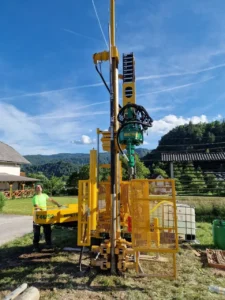


Geomechanical investigations are a key step in the planning and execution of all major construction projects. Their main purpose is to accurately determine the properties of soil and rock and to assess their suitability for construction or remediation.
The main tasks include:
-
assessment of the mechanical properties of soil,
-
determination of load-bearing capacity and settlement,
-
verification of slope stability,
-
analysis of groundwater influence and hydrogeological conditions.
Properly executed investigations reduce risks during construction and operation of structures and ensure long-term safety. They are particularly important for energy infrastructure, roads, and industrial facilities, where loads and the consequences of failures can be extremely high.
Geomechanical Investigations for Energy Facilities
1. For thermal power plants
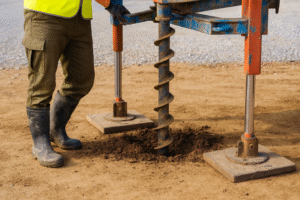
Construction of thermal power plants involves heavy loads due to massive buildings and heavy equipment. In industrial areas, soils are often altered – they may be saline, contaminated, or structurally weakened. Therefore, an accurate assessment of the bearing capacity of the foundation ground is essential.
Special emphasis is placed on predicting settlements and deformations of foundations, since stable foundations are crucial for the safe operation of the entire plant. Methods used include static and dynamic probing, laboratory strength testing, and computer modeling.
2. For hydroelectric power plants
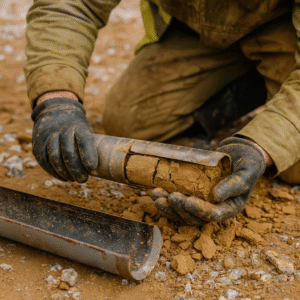
Hydroelectric plants are subject to constant and variable hydraulic loads. In these projects, the safety of dams and embankments is critical. Geomechanical investigations focus on the analysis of filtration processes, assessment of erosion risks, and stability of slopes in the immediate vicinity of dams.
Advanced methods are used to model potential extreme scenarios, such as dam failure or soil movement, ensuring long-term safety and efficient operation of hydroelectric plants.
3. For renewable and transmission facilities
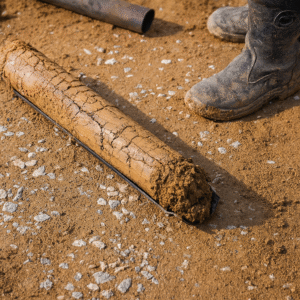
Energy facilities such as wind and solar power plants and transmission lines require tailored investigations.
-
For wind turbines, foundation stability is key, as structures are exposed to strong and uneven wind loads.
-
For solar power plants, the effects of seasonal changes in soil moisture and temperature on both soil and structures are assessed.
-
For transmission lines, the stability of pylons must be verified on a wide variety of soils, from rocky areas to swampy terrains.
In addition, for all energy facilities, it is important to assess the impact of seismic activity on structural stability.
Geomechanical Investigations for Infrastructure
1. For rehabilitation
Existing infrastructure deteriorates over time. Effective rehabilitation requires assessing the remaining service life of structures and diagnosing causes of damage such as subsidence, vibrations, and overloading. Based on investigation results, remediation measures tailored to actual soil conditions are designed.
2. For reconstruction
When reconstructing structures, one of the main challenges is compatibility of new structures with existing foundations. Geomechanical investigations allow prediction of potential deformations under increased loads and consideration of hydrogeological changes that occurred during the structure’s lifetime.
3. For roads
Road infrastructure is exposed to continuous traffic loads and weather conditions. Investigations include diagnostics of cracks, rutting, determination of the load-bearing capacity of road embankments and subgrade. Special attention is given to groundwater influence and insufficient drainage.
Based on analyses, recommendations are made for soil stabilization and use of modern materials, extending the service life of road infrastructure.
Geomechanical Investigations for Natural Disaster Remediation
Natural disasters such as landslides, floods, and earthquakes require rapid and precise response. Geomechanical investigations enable assessment of consequences: volumes of displaced masses, slope stability, erosion risks, and impacts on existing structures.
After earthquakes, it is crucial to verify the strength of foundations and possible structural damage. Modern methods such as ground-penetrating radar, geophysical surveys, and 3D modeling are used to predict recurring events.
Based on the data, preventive measures are planned – slope stabilization, drainage systems, and construction of anti-landslide structures.
Conclusion
Geomechanical investigations are the foundation of safe and sustainable construction. They ensure structural stability, reduce risks, and optimize remediation costs.
An integrated approach combining field research, laboratory testing, and computer modeling provides the best results.
Investment in high-quality geomechanical investigations pays off in the long term – ensuring greater reliability of structures, safety of inhabitants, and stability of infrastructure.
Successful project execution requires cooperation with experts – geologists and engineers whose knowledge and experience guarantee long-term stability and project success.