
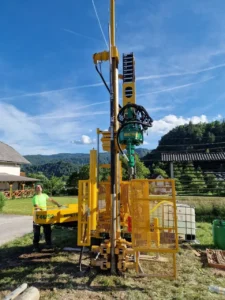


Why geological–geomechanical soil investigations are essential
Construction always starts with the ground, so understanding its composition is crucial. An incorrect assessment of the geomechanical composition of the soil can cause foundation settlement, wall cracking, or even the risk of a total structural collapse. Although such studies may sometimes seem like unnecessary costs, reports on soil composition are in fact an investment in project safety and durability. Accurate investigations reduce risks and enable designers to propose the most appropriate foundation solutions. Every build—from a simple house to a complex infrastructure asset—depends on the quality of soil investigations and analyses.
Reports on soil composition
1. What is a report on soil composition?
A report is a professional document that describes in detail the type, structure, and mechanical properties of the soils at a given location. It provides designers with the data needed for the safe design of foundations and structures. Without such a document, design is often guesswork, which can lead to complications later on. Its content is based on field investigations, laboratory analyses, and expert interpretation. For any serious construction project, reports on soil composition are essential.
2. How the report is prepared
Preparing reports on soil composition involves several phases, starting with a review of existing data and geological maps. Field investigations follow—such as boreholes, soundings/penetration tests, and sampling for laboratory testing. In the laboratory, specialists determine physical and mechanical properties such as density, moisture content, and shear strength. Finally, a written report is compiled with charts, results, and recommendations. The entire process is systematic and follows applicable standards.
3. The report’s role in design and construction
The report is not a mere formality—it is the basis for foundation design. Using its data, designers specify the depth, width, and type of foundation. This ensures that the structure will be stable and resistant to influences such as settlement or soil movement. Without the report, an inappropriate foundation solution may be chosen, leading to costly remediation. In the long run, preparing reports on soil composition saves time and money for the investor.
Soil bearing-capacity analyses
1. Methods for assessing bearing capacity
Soil bearing capacity is the maximum load the ground can sustain before excessive deformation occurs. It is assessed using methods such as the Standard Penetration Test (SPT), static and dynamic penetration testing (CPT) and related in-situ tests, along with laboratory testing. Each method yields different data that are combined into an overall assessment. These analyses are crucial for deciding whether shallow foundations are feasible or special measures are required.
2. How bearing-capacity analyses are produced
Analyses are carried out in laboratories on samples taken from site. Results indicate how much load the soil can carry before excessive settlement occurs. Based on this, designers determine allowable foundation pressures for the structure. Such analyses are applied to both single-family houses and large infrastructure projects. Without them, construction would be too risky.
3. Typical issues and early detection
Common problems arise when soils have insufficient bearing capacity or are highly heterogeneous. If detected early, additional measures—such as ground improvement, soil stabilization, or deep foundations—can be adopted. Without investigations, damage may appear soon after completion. Bearing-capacity analyses protect investors from unwelcome surprises and avert high remediation costs.
Geological–geomechanical reports
1. Difference between a geological and a geomechanical report
A geological report primarily describes natural soil characteristics—composition, stratigraphy, and the geological history of the area. A geomechanical report focuses on mechanical properties and behavior under load. In practice, a combination of both is often required to provide a complete picture; projects are most successful when a joint report is prepared.
2. Preparing geological–geomechanical reports
Such reports combine geological descriptions with geomechanical analyses. They include results of field investigations, laboratory tests, and expert interpretations. They are typically required for obtaining a building permit, as they confirm the suitability of the ground for the proposed structure. They also give investors and designers a clear view of risks. Without this document, administrative authorities often reject permit applications.
3. Geomechanical soil composition and its impact
Geomechanical soil composition dictates the appropriate foundation approach. Firm, homogeneous soils may allow shallow foundations; soft or heterogeneous soils often require deep foundations such as piles. A wrong assessment can lead to dangerous settlement or tilting. Thorough assessment before construction is therefore essential to ensure long-term stability.
Performing investigations and professional supervision
1. Conducting investigations of foundation-soil bearing capacity
These investigations involve boreholes, in-situ measurements, and sampling directly on site. Because soils can be heterogeneous, testing at multiple locations is necessary. The results enable designers to prepare accurate plans. Without such investigations, bearing-capacity assessments would often be unreliable.
2. Geomechanical professional supervision
During construction, geomechanical supervision ensures that foundations are executed in accordance with the reports and analyses. If deviations occur, timely solutions are proposed. This prevents errors with long-term consequences and serves as an additional quality safeguard.
3. Site inspection before documentation
Every project begins with a site inspection that includes a visual assessment, review of geological maps, and preliminary measurements. This step determines which investigations are needed and reveals potential issues such as groundwater, heterogeneous soils, or landslide susceptibility. It is the first step toward a high-quality report.
Post-construction geotechnical monitoring
After completion, post-construction geotechnical monitoring is recommended to track the long-term behavior of the ground and the structure. Settlement, displacement, and structural stability are measured over time. Such monitoring is mandatory for major infrastructure works, dams, and tunnels. It prevents later damage and accidents and is a continuation of professional supervision that ensures the asset’s durability.
Practical value of geological and geomechanical reports
1. Cost reduction
Well-prepared geological and geomechanical reports help avoid unnecessary extra works. When soils are correctly assessed, construction is faster and cheaper; misjudgments lead to costly repairs and delays. These investigations thus deliver long-term financial benefits.
2. Increased safety
Bearing-capacity analyses and professional supervision directly affect structural safety. Stable foundations ensure the structure withstands all design loads, protecting lives and property. Without investigations, risks are far higher.
3. Role in permitting
For a building permit, these reports are mandatory attachments. Authorities require proof that the ground is suitable. Without them, the investor cannot proceed. The reports therefore also have legal–formal importance and build stakeholder confidence.
Cost and factors that influence pricing
The cost of a geomechanical report and investigations depends on several factors, chiefly the size of the project, site complexity, and investigation depth. For simple single-family houses, costs are relatively low; for large infrastructure projects, they can be substantially higher. Costs can be optimized through good preparation and timely planning of investigations. Importantly, this is an expense that prevents much greater losses down the line.
Conclusion
Professional preparation of reports on soil composition, detailed soil bearing-capacity analyses, and systematic post-construction geotechnical monitoring are the foundations of safe, durable construction. Early investigations reduce costs and risks for investors, while reports enable designers to choose better, safer solutions. The role of geological–geomechanical investigations is both technical and economic: they underpin structures that remain safe and reliable for decades.