
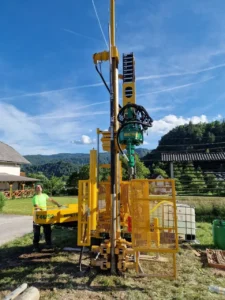



Efficient groundwater drainage is one of the key factors for soil stability, protection of building structures, and the long-term safety of infrastructure facilities. Professional design of vertical and horizontal drainage systems enables control of groundwater levels, reduction of pore pressure in soils, and improvement of soil geotechnical properties.
Drainage systems are used in the construction of roads, industrial facilities, embankments, retaining structures, on slopes, and in areas with a high groundwater level. A properly designed drainage system prevents soil settlement, reduces the risk of landslides, and extends the service life of structures.
Our company performs professional drainage system design based on geotechnical investigations, hydraulic calculations, and modern engineering design methods.
What Are Drainage Systems
Drainage systems are engineering solutions designed for the controlled removal of groundwater or infiltration water from soil. Their purpose is to reduce water pressure in the ground, improve soil bearing capacity, and protect construction structures.
Two basic types of drainage systems are most commonly used:
- vertical drainage systems
- horizontal drainage systems
Both systems have different functions and are used depending on the geological and hydrological conditions at the construction site.
Difference Between Vertical and Horizontal Drainage
Type of drainage | Purpose | Typical application |
Vertical drainage | acceleration of soil consolidation | soft and saturated soils |
Horizontal drainage | lowering groundwater level | slopes, embankments, retaining structures |
Vertical drainage allows faster expulsion of water from the soil, which shortens the soil settlement period. Horizontal drainage enables continuous removal of groundwater and reduces hydrostatic pressure in the soil.
When Drainage System Design Is Necessary
Designing a drainage system is necessary in many construction and infrastructure projects, especially where groundwater affects soil or structural stability.
Typical situations include:
- construction on soft or water-saturated soils
- high groundwater levels
- stabilization of slopes and embankments
- construction of embankments and transport infrastructure
- protection of foundations and basements from water
- prevention of landslides and soil erosion
Timely drainage system design significantly reduces risks during construction and during the operational life of the structure.
Drainage System Design Process
Professional drainage system design is carried out in several stages. Each stage is based on geotechnical analyses, hydraulic calculations, and engineering design methods.
Geotechnical and Hydrogeological Investigations
The first step is the analysis of geological and hydrological conditions at the site.
At this stage the following are performed:
- drilling and soil sampling
- laboratory soil analysis
- determination of soil permeability coefficient
- groundwater level analysis
The results of these investigations allow determination of the appropriate type of drainage system.
Hydraulic Calculations and Drainage Layout Design
At this stage the optimal layout of drainage elements is determined.
The following factors are considered:
- geological soil layers
- groundwater flow direction
- terrain topography
- loads acting on the soil
Based on geotechnical data, hydraulic calculations are performed to determine:
- spacing between drains
- drainage installation depth
- drainage capacity
- water removal rate from the soil
The goal of design is to achieve maximum system efficiency with minimal implementation cost.
How Materials for Drainage Systems Are Selected
In the design and construction of drainage systems we use several types of materials, each performing a specific function. A system typically includes geotextile, drainage pipes, crushed stone, and geogrid.
Material selection is always carried out individually for each project. The following factors are considered:
- type and structure of soil on the site
- groundwater level
- drainage installation depth
- amount of precipitation in the region
- expected loads on the system
This approach ensures that the drainage system remains reliable and efficient in the long term.
Geotextile
In our projects, geotextile serves as a filtration and separation layer. It is used to separate different layers of the base and to wrap drainage pipes, protecting the system from clogging.
When selecting geotextile we consider several key properties.
- Density. For most drainage systems, the optimal density is 100–150 g/m². Denser material has higher tensile strength but may allow slightly less water permeability.
- Filtration coefficient. This parameter indicates how much water the material can transmit within a given time period. For an effective drainage system, it is important that geotextile maintains good water permeability even during long-term use.
- Strength. We select materials resistant to mechanical loads, pressure, and stretching. This is especially important when installing drainage at greater depths or in soils with higher loads.
- Material width. During installation, the geotextile must completely cover the drainage layer. We always provide overlapping installation to prevent soil from entering the filtration layer.
The material production technology is also important. For example, geotextiles produced with thermally bonded fibers may have reduced permeability, therefore only suitable types are used in drainage systems.
Drainage Pipes
Pipes are the key element of a water removal system, so their selection requires special attention. Pipe material and structure must withstand soil pressure and water flow for a long time.
Several factors are considered when choosing pipes.
- Soil type
In sandy soils, pipes with larger openings or without perforation can be used. In clay or loamy soils, perforated pipes are used to allow efficient collection of water from the surrounding soil.
- Groundwater level
If the groundwater level is high, pipes designed for greater hydrostatic loads are used.
- Precipitation levels
In regions with heavy rainfall, it is important to use pipes with high flow capacity and protection against clogging.
- Pipe diameter
The diameter is determined according to the expected water volume. Proper diameter selection ensures sufficient system flow capacity and prevents overload.
Crushed Stone
Crushed stone forms the drainage layer through which water freely flows to the pipes. Several important parameters are considered when selecting it.
Fraction size
- 5–20 mm — used for drainage of smaller areas, such as garden paths or around foundations.
- 20–40 mm — suitable for drainage around foundations and most landscape drainage systems.
- 40–70 mm — used for larger areas and structures with higher loads.
Type of crushed stone
- Granite crushed stone has high strength, frost resistance, and a long service life, making it common in more demanding projects.
- Limestone crushed stone is more affordable but has somewhat weaker mechanical properties.
Material cleanliness
Only clean crushed stone without clay, dust, or organic impurities is used, as these can reduce permeability and worsen drainage system performance.
Geogrid
Geogrids are used when the base must be reinforced and the drainage layer stabilized. This structure consists of polymer strips laid on a prepared base and filled with crushed stone, soil, or other materials.
When selecting a geogrid we consider:
- Type of task
For drainage systems we select materials with high tensile strength that can effectively distribute loads.
- Load
The higher the load (for example on access roads or parking areas), the stronger the geogrid must be.
- Soil type
Soil bearing capacity influences geogrid construction and cell size.
- Operating conditions
Temperature conditions, moisture, and possible presence of aggressive substances in the environment are considered.
When selecting a geogrid it is important to evaluate not only cell height and size but also the quality of connections between elements, as this directly affects durability.
Integration With Other Water Management Systems
A drainage system must be coordinated with other water management systems at the construction site.
This includes:
- stormwater drainage systems
- surface drainage systems
- foundation protection
- soil stabilization measures
Integrated planning ensures optimal performance of the entire water drainage system.
Design of Vertical Drainage
The main purpose of a vertical drainage system is to lower the groundwater level in a specific area.

Vertical systems are used in cases where conventional drainage systems are not sufficiently effective — for example in areas with low soil permeability and high water saturation.
Examples where vertical drainage is necessary include:
- strongly marshy areas
- sites located in lowlands with flat relief and far from natural drainage points
- complex geological conditions where groundwater is located below an impermeable rock layer
Vertical drainage may function either as a purely drainage system or as a drainage-irrigation system.
In the first case, water is collected in wells and pumped to the discharge point.
In the second case, water is stored in reservoirs after pumping and can be used for irrigation during dry periods.
Operating Principle of Vertical Drainage and Formation of a Depression Cone
During operation of a system of wells, surrounding soil layers gradually dry out — forming what is known as a depression cone.
A difference in hydrostatic pressure forms between this zone and the surrounding moisture-saturated soil. Due to this pressure difference, groundwater begins to move toward the wells, gradually lowering the groundwater level across the controlled area.
Water collected in wells may be removed in two ways:
- naturally, through infiltration into deeper filtration soil layers
- forcibly, using pumping equipment
Structure of a Vertical Drainage System
A vertical drainage system consists of a network of vertical wells. Their depth is typically 20–50 meters, depending on groundwater depth.
A pipe is installed inside the well and surrounded by sand-gravel backfill with a thickness of at least 10 cm. This loose material layer acts as a filter and protects the system from clogging.
Water first passes through the filtration layer and then collects in the well, from where it can:
- infiltrate into aquifer layers
- or be pumped out
The drainage system may also include additional reinforcement wells. These have smaller diameters and help dry the soil between the main wells, significantly increasing system efficiency.
Design of Horizontal Drainage
Types of Horizontal Drainage Systems: Open and Closed Drainage

Horizontal drainage systems can be implemented in two basic forms.
Open drainage
A system of open channels through which water flows from the surface or upper soil layers.
Closed drainage
A system of underground artificial watercourses — drainage pipes (drains) that collect and remove water beneath the ground surface.
Most Common Types of Horizontal Drainage
Several types of horizontal drainage systems are used in practice.
- Ring drainage (circular drainage)
Installed around a protected structure or area to lower the groundwater level within the protected perimeter.
- Wall drainage (foundation drainage)
Consists of drainage pipes with filter backfill installed on impermeable soil along the outer side of the building. Such systems effectively protect foundations from water intrusion.
Main Elements of a Horizontal Drainage System
A horizontal drainage system consists of several key elements.
- Drainage pipes (drains)
Pipes through which water is removed from the system. They may be made of plastic, asbestos cement, concrete, or reinforced concrete.
- Filter backfill
Composed of several material layers. Gravel is usually used inside, while the outer layer often consists of natural sand. The composition and thickness depend on soil type, drainage design, and water flow volume.
Advantages of Professional Drainage Design
Professional designers take into account site characteristics: terrain relief, soil composition, groundwater depth, and foundation properties. This allows:
- selection of the most efficient drainage type: wall, ring, surface, or combined
- proper arrangement of all system elements: correct placement of wells and drains, trench slope, pipe installation depth, crushed stone filter layer, and backfilling
- compliance with regulations and obtaining required approvals during project validation
Examples of Drainage System Applications
Drainage systems are used in many construction projects.
Typical examples include:
- Road construction on soft soils
Vertical drainage accelerates soil consolidation and enables safe embankment construction.
- Slope stabilization
Horizontal drainage reduces groundwater pressure and prevents landslides.
- Industrial facilities
Drainage systems ensure stable foundations and prevent structural damage.
- Embankment construction
A combination of vertical and horizontal drainage enables effective drainage and soil stabilization.
Standards and Regulations
The main requirements for drainage systems in Slovenia arise from a combination of national legislation and European standards implemented as Slovenian SIST standards.
Basic Laws and Regulations
The Water Act regulates water protection and use, wastewater discharge, protection of groundwater and surface waters, sanitary protection zones, and pollution prevention.
Specific decrees define limit values for pollutants discharged into water bodies or public sewer systems and establish requirements for stormwater management (priority use, treatment, and pollution prevention).
Operational programs for municipal wastewater collection and treatment define obligations for equipping settlements and facilities with sewer systems and treatment plants.
European and Slovenian SIST Standards
European EN standards are implemented in Slovenia as SIST EN standards.
- SIST EN 752:2017 — Drain and Sewer Systems Outside Buildings
Defines objectives, functional requirements, and principles for design, operation, maintenance, and rehabilitation of external sewer systems from the building outlet to the receiving body or treatment plant.
Construction and testing of gravity and pressure sewer pipelines in the ground, including requirements for installation, tightness, and trench compaction.
Elements of internal building drainage systems such as gutters, water traps, roof drains, and inspection chambers.
These standards define minimum requirements regarding hydraulic capacity, strength, tightness, corrosion resistance, maintenance accessibility, and system safety.
Stormwater Runoff and Infiltration
Slovenian sewer regulations require priority infiltration of rainwater on the plot whenever possible to prevent overloading of combined sewer systems.
European and Slovenian standards do not regulate detailed design of infiltration structures, therefore in practice the German standard DWA-A 138E and the British guideline CIRIA C753 are commonly used for calculating infiltration volumes and geometry.
Example: during the design of a stormwater drainage system for a campus in Ljubljana, a modular infiltration block was selected based on calculations according to DWA-A 138E, with overflow discharge to a watercourse during extreme rainfall.
Environmental and Operational Requirements
All drainage and sewer systems must comply with EU environmental protection requirements under the Water Framework Directive 2000/60/EC, implemented in Slovenian legislation.
Design and operation must ensure:
- prevention of groundwater and surface water pollution
- adequate treatment of wastewater before discharge into water bodies or soil
- resilience of systems to floods and extreme rainfall
Typical Requirements for Drainage System Projects in Slovenia
In practice, a drainage system project in Slovenia usually requires:
- reference to the Water Act and relevant decrees on wastewater discharge and stormwater management
- application of SIST EN 752, EN 1610, and SIST EN 1253 standards
- priority infiltration of rainwater on the plot where hydrogeology allows it, calculated using recognized methods such as DWA-A 138E or CIRIA C753
- justification that the system does not negatively affect groundwater or neighboring plots and complies with pollutant limits and protection zones
Compliance with these standards ensures safety, reliability, and long-term performance of drainage systems.
Why Choose Our Company
Our company has many years of experience in geotechnical design and drainage system planning.
We provide clients with:
- professional geotechnical analysis
- precise hydraulic calculations
- optimized drainage system design
- support during project implementation
- solutions adapted to specific site conditions
By combining expert knowledge, modern design methods, and practical experience, we deliver reliable and efficient soil drainage solutions.
Entrust the design of your drainage systems to professionals — we will ensure reliable groundwater drainage and soil stability on your site. Our experience and precise engineering calculations guarantee safety, long service life, and economic efficiency of the solution. Contact us today to receive an individual project fully adapted to your conditions.