
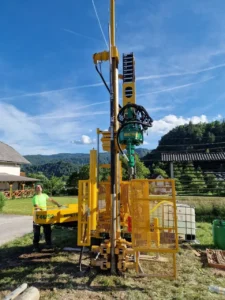




Dynamic penetrometric sounding is one of the most commonly used methods in engineering-geological investigations. It is intended for assessing the bearing capacity, density, and mechanical properties of foundation soils, which is crucial for proper foundation design. Reliable determination of soil parameters is the basis for safe and economical planning in both civil engineering (roads, railways, embankments) and structural engineering (buildings, industrial facilities), as well as in infrastructure construction.
 The most frequently used methods include:
dynamic penetrometer DP sounding;
dynamic penetrometer Panda DCP sounding;
dynamic penetrometer SPT (Standard Penetration Test) sounding.
Each method has its own specifics, but all are based on the principle of impact-driven penetration of a cone into the soil.
Dynamic Penetrometer DP Sounding
Dynamic Penetrometer DP sounding is a dynamic penetration test performed using a dynamometric penetrometer of the DP type.
 Short description
This is an in-situ soil investigation in which a probe (rod with a cone tip) is driven into the soil using controlled-energy blows. During the test, the following is measured:
the number of blows per defined depth, or
the penetration depth for a defined number of blows.
Purpose of the investigation
assessment of soil compactness and strength;
identification of heterogeneities in the geological profile;
determination of the depth of weak or strengthened layers;
support in designing foundations, roads, and other geotechnical works.
Meaning of the DP designation
DP = Dynamic Penetrometer
(In the European system the designations DPL, DPM, DPH are frequently used — light, medium, heavy penetrometers depending on hammer mass and drop height.)
Test result
DP sounding data are usually shown as a graph of blow count versus depth, allowing an indirect assessment of:
soil deformation modulus,
soil bearing capacity,
soil state (loose, medium dense, dense etc.).
Panda DCP Dynamic Penetrometer Sounding
Panda DCP dynamic penetrometer sounding is a type of dynamic penetration test performed using the lightweight portable Panda penetrometer (Dynamic Cone Penetrometer — DCP).
 Basic concept of the method
A conical probe is driven into the ground using blows from a small-mass hammer. The device records:
the energy of each blow,
the penetration depth of the cone,
the number of blows per defined depth.
Panda DCP is characterized by highly precise registration of blow energy and soil resistance, which increases the reliability of results.
Purpose of the investigation
assessment of weak and fill soils;
evaluation of uniformity and quality of soil improvement in foundations and embankments;
diagnostics of soils in hard-to-access areas;
fast field measurements during construction of roads, foundations, and temporary surfaces.
Advantages of Panda DCP
lightweight and portable instrument;
suitable for shallow investigations (typically up to 6–8 m);
correlates with other methods (SPT, density characteristics).
SPT (Standard Penetration Test) Dynamic Penetrometer Sounding
SPT dynamic penetrometer sounding is the standard dynamic penetration test widely used in geotechnics to assess soil properties.
Basic concept of the method
A standard metal sampler with a conical tip is driven into the soil using blows from a 63.5 kg hammer dropped from a height of 76 cm (according to ASTM/ISO standards).
The number of blows required to drive the sampler 30 cm after the initial 15 cm seating is recorded.
This value is called the SPT N-value.
Purpose of the investigation
assessment of density and strength of granular soils (sand, gravel);
determination of soil bearing capacity;
detection of weak layers and irregularities;
design of foundations, piles, and earth structures.
Advantages of the method
highly standardized, with comparable data across locations;
provides a direct measurement of soil resistance for engineering calculations;
can be combined with laboratory soil testing.
Outcome
The SPT N-value, used for:
determining soil density and stiffness,
calculating pile and foundation bearing capacity,
classifying soils according to standards (e.g., USCS).
Advantages and Limitations of the Methods
Advantages
fast and cost-effective execution;
suitable for a wide range of project types;
enables real-time field interpretation;
useful in difficult-to-access areas (especially Panda DCP).
Limitations
low effectiveness in coarse-grained and rocky soils;
results are empirical and require experienced interpretation;
influence of groundwater saturation on measurements.
SPT is generally considered the reference method, while DP and Panda DCP are excellent tools for rapid preliminary assessment.
Standards and Guidelines
The use of these methods is supported by technical standards and regulations:
SPT is covered by international standards (e.g., EN ISO 22476-3);
DP and Panda DCP comply with guidelines for dynamic penetrometric sounding (EN ISO 22476-2);
regular equipment inspection and calibration are required.
Standards ensure comparability of results and a high level of design safety.
Practical Applications
 These methods are frequently used for:
analysis of foundation bearing capacity of residential and commercial buildings;
geotechnical investigations for transport infrastructure;
verification of soil improvement (vibro-compaction, embankment strengthening);
reconstruction and condition assessment of existing structures.
Field reports show that the combination of DP, Panda DCP, and SPT provides optimal understanding of vertical soil variability.
Conclusion
Dynamic penetrometric sounding is indispensable for foundation design and verification. A combined approach:
DP sounding enables rapid orientation-level assessment,
Panda DCP is ideal for shallow and hard-to-access areas,
SPT provides standardized and widely comparable results.
Proper data interpretation enhances safety, reliability, and cost-efficiency in engineering design.